Boxford Water Meadow

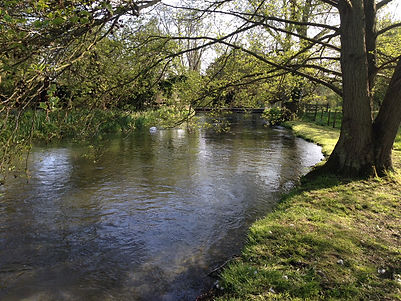


Water meadows are man-made, and form an important part of our agricultural heritage. There are two types. ‘Catchwork’ meadows date from the medieval period and were used on slopes to irrigate the hillsides. The more sophisticated ‘Bedwork’ system was used from the 1700s until the mid-20th century. It uses a series of dams, sluices and water channels that can divert water from a river to admit a shallow layer of water to selected parts of a meadow. The Boxford site is a ‘bedwork’ water meadow. A map from 1899 showed the extent of the water meadows, stretching along the Lambourn from Weston through Boxford to Woodspeen. At Boxford, the drains, sluices and some of the water channels can still be seen.
Water meadows were an important part of ‘corn and sheep’ agriculture in this region - flooding the fields in a controlled way in early spring fertilised and warmed the soil, allowing an earlier and better hay crop. It also produced improved spring pastures enabling larger sheep flocks to be kept. Although very labour-intensive, it is estimated that water meadows commonly doubled the value of meadow land and were widely used in the chalk areas of Hampshire, Dorset, Wiltshire and West Berkshire. However, most water meadows were destroyed between 1918 and 1960. With the introduction of artificial fertilisers, mechanisation and cheaper imported grain and lamb, they became uneconomical to maintain. In the 1950s and 1960s, the government even offered grants to level old water meadows to increase food production!
Boxford water meadows are rich in biodiversity - 17 species of grass, 7 species of sedge and 76 species of grassland herb have been recorded. In addition, the meadows support breeding snipe, barn owls, freshwater crayfish Astacus pallipes and brook lamprey. The insect fauna is diverse, with species rare in Berkshire such as the beetles Cantharis pallida and Subcoccinella 24-punctata and the bug Neophilaenus campestris.
The owners are responsible for the ongoing condition of the area, with the overall aim to enhance the biodiversity. They have identified two key objectives – to improve the habitat for Desmoulin’s whorl snail (Vertigo moulinsiana) and in the areas where the whorl snail is unlikely to thrive, to restore the swamp and tall fen habitats. Desmoulin’s whorl snail is an endangered species and must be protected. Unfortunately, they have very specific habitat requirements, requiring wet conditions all year long with water close to the surface but without prolonged flooding. In 1995, a large population of these snails were found at Boxford, although a recent survey (in line with other observations in the region) failed to find any.
WBCS volunteers regularly help the landowners with the restoration of the grasslands, by removing trees and cutting the meadow vegetation, stopping the site reverting to scrub. A survey by Natural England noted that the meadow was in good condition with a wide range of habitats available. Summer grazing is a more sustainable way of managing the vegetation – part of the site already has grazing cattle.
We are fortunate that a portion of these meadows still exist in Boxford - it is estimated that there are less than 800 hectares of this type of landscape left in the UK. With the meadows being designated as a “Site of Special Scientific Interest” and the River Lambourn being one of the best chalk streams with good water quality, it makes the Boxford Water Meadows a site of considerable importance in West Berkshire.